|
On the SMT shop floor, pickup loss is a metric that can never be completely eliminated—yet must be relentlessly attacked. It doesn't make the dramatic entrance of an equipment breakdown, but it cuts like a dull knife: every "click" of a nozzle dropping a component into the reject bin silently devours profit. For a single high-value chip, even a 0.5% pickup loss rate adds up to a substantial loss over the course of a year. Pickup loss, in plain terms, means the placement machine "picked it up but didn't place it." After the nozzle picks up a component, if recognition fails, vacuum is insufficient, or the posture is abnormal, the system judges that component as defective and discards it into the reject bin. Don't underestimate this action—it brings at least three costs: direct material loss, extended placement cycle time, and the labor and time cost of replenishing materials during cleanup.
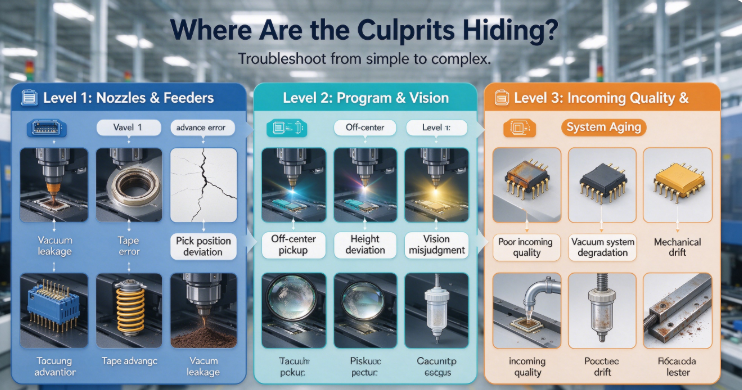
Where Exactly Are the "Culprits" of Pickup Loss Hiding?Based on extensive on-site debugging experience, the causes of pickup loss can be grouped into three levels, and troubleshooting should follow a "simple to complex" order. Level One: The "Physical Condition" of Nozzles and Feeders The nozzle is one of the most precise consumable parts of a placement machine. After prolonged use, nozzles may become clogged, have their inner diameter worn, or even crack—causing vacuum leakage, insufficient suction force, and components that are already tilted when picked up. Feeder problems are equally frequent: worn ratchet gears cause tape to not advance properly, aging springs cause pickup position deviation, and dust accumulation at the bottom causes tape jamming—all of which make the nozzle "miss" or "pick crooked." There's no shortcut for troubleshooting these issues: regular nozzle cleaning, establishing a consumption ledger, and periodic feeder calibration. One detail worth noting is that some high-end models have begun introducing nozzle health monitoring, which analyzes vacuum pressure curves to provide early warnings of wear—rather than passively replacing parts only after batch pickup loss occurs. Level Two: "Parameter Mismatch" Between Programs and Vision Systems Many times, pickup loss is not a hardware failure but the machine "thinking this component is wrong." When the nozzle pickup position is not at the component center, or the pickup height deviates (the industry standard is 0.05mm downward pressure after contact), the component enters the recognition stage in an incorrect posture. Vision system light source brightness and grayscale settings that don't match actual incoming materials, dirty lenses, or incorrectly entered reflection parameters can also cause qualified components to be "misjudged" as defective. The characteristic of these problems is strong regularity: a specific part number continuously experiences pickup loss, or a specific nozzle repeatedly fails on a specific component. Recalibrating pickup coordinates and debugging vision parameters against actual components often produces immediate results. Level Three: The "Chronic Disease" of Incoming Material Quality and System Aging Components with oxidized pins or deformed shapes inherently don't meet placement standards—they are "congenitally deficient." More insidious is the chronic degradation of the vacuum system: pipeline leaks, clogged filters, insufficient air pressure—these don't erupt suddenly but keep every pickup at a "critical state." Meanwhile, screw wear and guide rail precision degradation from high-speed motion make "parameters are in place, but actual position isn't" the norm.
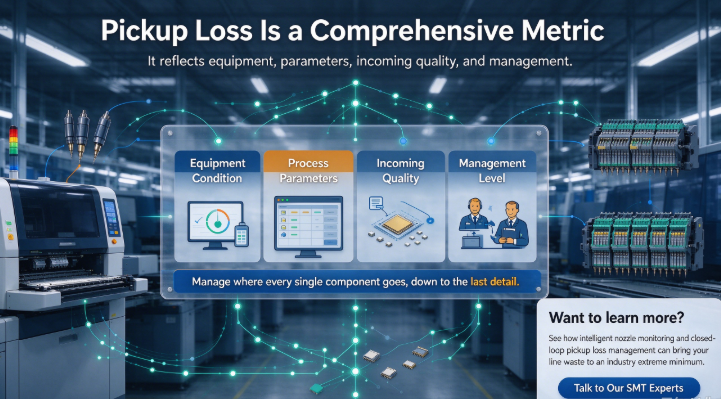
From "Firefighting" to "Prevention"The highest level of pickup loss management is not quickly identifying the cause after loss occurs, but preventing loss from happening at all. This requires shifting actions from "post-repair" to "process monitoring." Some leading production lines are already practicing real-time pickup loss analysis: when a nozzle's pickup loss rate exceeds a preset threshold (such as 0.05%), the system automatically locks that nozzle and prompts inspection—rather than only noticing after a large batch of materials is scrapped. A further closed-loop management approach links pickup loss data with feeder maintenance records and nozzle service life, triggering maintenance work orders before failures occur. Pickup loss rate is not an isolated equipment metric—it is a comprehensive projection of equipment condition, process parameters, incoming material quality, and management level. Companies that push pickup loss to the extreme are often not those with the most expensive equipment, but those that manage "where every single component goes" down to the last detail.
Want to know how our placement machines use intelligent nozzle monitoring and closed-loop pickup loss management to keep your production line's waste at the industry's extreme minimum? |
Is Your SMT Pickup Loss Rate Stubbornly High? From "Invisible Waste" to "Visible Profit"
24 सित॰ 2026 ETON