|
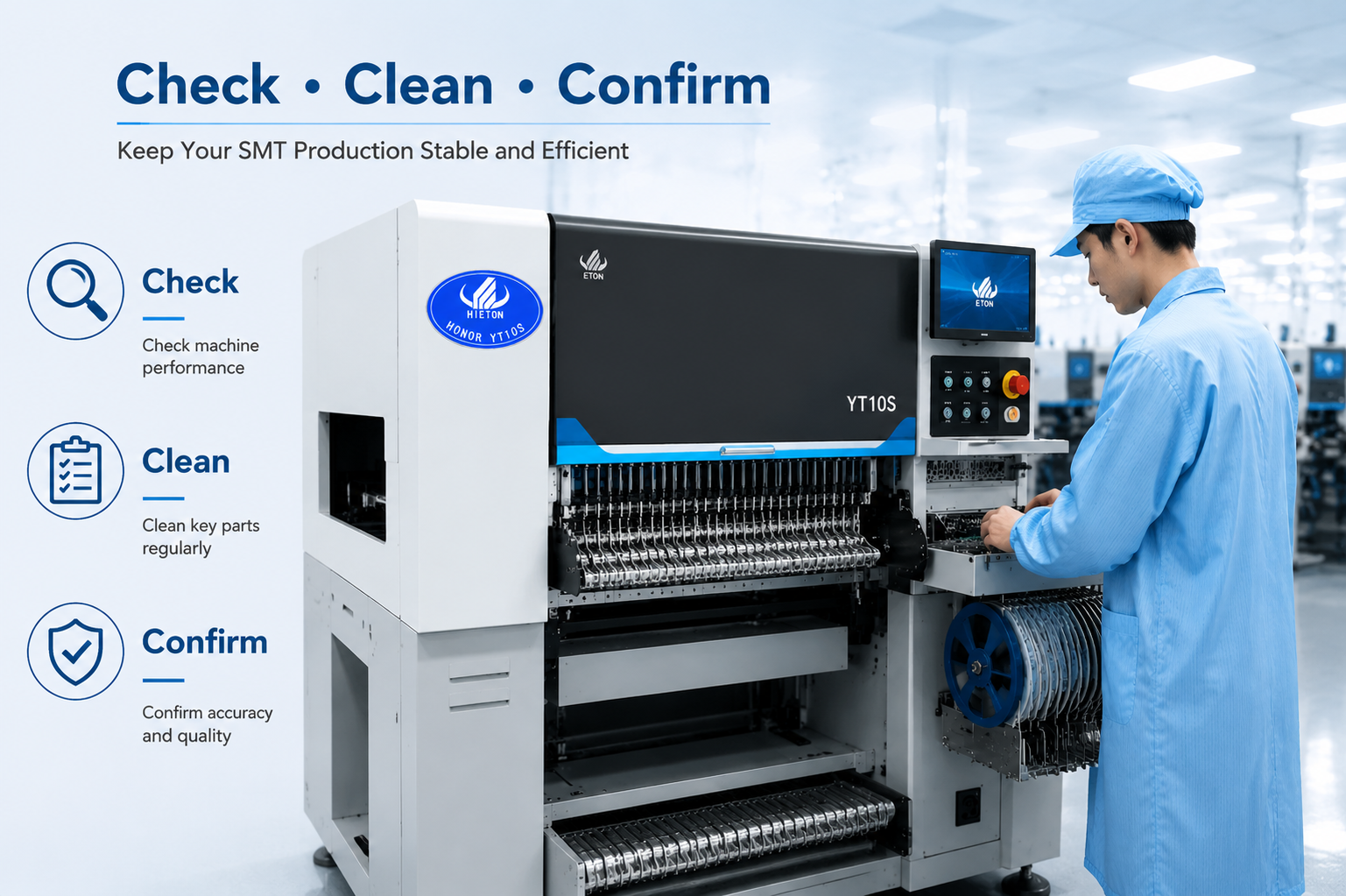
In modern electronics manufacturing, SMT pick and place machines are the beating heart of high-speed, high-precision PCB assembly. These systems operate continuously, placing thousands—even millions—of components with micron-level accuracy.
But even the most advanced equipment is only as reliable as the maintenance behind it. Without a disciplined upkeep routine, you risk degraded placement accuracy, rising component loss, and costly unplanned downtime.
At ETON, we've worked alongside manufacturers worldwide to optimize SMT line performance. This practical maintenance checklist covers daily, weekly, and monthly tasks to help you protect your investment and sustain peak productivity.
Why Regular Maintenance Is Non-Negotiable
A pick and place machine runs at extreme speeds, subjecting critical components to constant mechanical and pneumatic stress. Neglecting maintenance often leads to:
-
Declining placement accuracy and rising defect rates
-
Frequent pickup failures and increased component waste
-
Premature wear on nozzles, feeders, and drive systems
-
Unexpected machine stoppages that disrupt production schedules
Conversely, structured preventive maintenance ensures that every subsystem—nozzles, feeders, vision, placement heads, conveyors, and vacuum—operates in harmony, delivering consistent quality batch after batch.
📅 Daily Maintenance Checklist (Operator-Level)
Daily checks are your first line of defense. Perform these at the start of each shift (approx. 15 minutes).
1. Nozzle Cleaning and Inspection
Nozzles directly determine pickup reliability and placement precision.
-
✔ Wipe nozzle tips gently with lint-free cloth and isopropyl alcohol to remove solder paste residue and dust.
-
✔ Inspect tips under magnification for chips, cracks, or wear.
-
✔ Verify that vacuum holes are clear using a fine pin or cleaning tool.
-
✔ Run a short test cycle to confirm stable component pickup.
⚠️ A clean nozzle is the single most effective way to reduce pickup errors.
-4.png?w=536&h=769)
2. Feeder and Component Supply Check
Feeders must deliver components smoothly and accurately.
-
✔ Confirm each feeder is securely seated in its slot.
-
✔ Check tape advancement for proper pitch and smooth motion.
-
✔ Remove any tape fragments, dust, or debris from feeder mechanisms.
-
✔ Listen for abnormal sounds during indexing.
3. Vision System Quick Inspection
The vision system ensures correct component alignment and Mark point recognition.
-
✔ Wipe camera lenses (upper and lower) with appropriate optical cleaning tools.
-
✔ Verify that illumination LEDs are bright and uniform.
-
✔ Check that PCB fiducial marks are being detected without errors.
4. Vacuum System Health Check
Vacuum pressure is vital for picking and holding components during high-speed movement.
-
✔ Monitor vacuum pressure readings on the machine display—confirm they meet specification.
-
✔ Inspect air hoses for kinks, leaks, or disconnections.
-
✔ Note any increase in pickup failure rates and investigate immediately.
📆 Weekly Maintenance Checklist (Technician-Level)
Weekly tasks involve deeper cleaning and mechanical verification. Allocate 1–2 hours per week.
1. Comprehensive Machine Cleaning
2. Moving Parts Inspection and Lubrication
High-speed axes demand smooth, friction-free motion.
-
✔ Inspect X/Y guide rails and linear motors for wear or contamination.
-
✔ Apply recommended grease/oil to lubrication points in strict accordance with the machine manual (over-lubrication can attract dust).
-
✔ Check drive belts for tension, cracks, or fraying.
-
✔ Tighten any loose mechanical couplings or screws.
3. Placement Accuracy Verification
Regular accuracy checks help catch drift before it affects quality.
-
✔ Run a glass substrate or dedicated calibration tool to test placement repeatability.
-
✔ Pay extra attention to 0201/01005 components, fine-pitch QFPs, and BGAs.
-
✔ If deviations exceed tolerance, schedule a calibration (see monthly section).
📆 Monthly Maintenance Checklist (Engineer-Level)
Monthly maintenance is about system-level performance review and proactive part replacement.
1. Full System Calibration
Calibration ensures the machine stays within its original accuracy specifications.
-
✔ Perform vision calibration (camera-to-head offset).
-
✔ Execute placement head calibration (rotational center and Z-axis height).
-
✔ Verify machine alignment (X/Y mapping and thermal compensation parameters).
2. Wear Parts Replacement (Proactive)
Certain consumables have finite service lives. Replace them before they fail:
💡 Keeping a minimum safety stock of these parts is a best practice to avoid production halts.
3. Production Data Review
Use the machine's built-in data logging to assess overall health:
-
Analyze placement accuracy trends over time
-
Review error logs and pickup failure rates by head/feeder
-
Track component loss statistics
-
Compare OEE (Overall Equipment Effectiveness) against targets
Data-driven insights allow you to prioritize maintenance actions where they matter most.
🏆 ETON Best Practices for SMT Maintenance Excellence
To transform maintenance from a chore into a strategic advantage, we recommend:
✅ Build a Formal Maintenance Schedule
Assign clear daily/weekly/monthly responsibilities to operators, technicians, and engineers. Post checklists directly on the machine for easy reference.
✅ Keep Detailed Maintenance Records
Log every action:
-
Cleaning dates and findings
-
Parts replaced (with dates and batch numbers)
-
Calibration results
-
Abnormal events and corrective actions
Good records enable predictive maintenance and support equipment resale value.
✅ Use OEM or Certified-Grade Spare Parts
Non-genuine components often compromise accuracy and longevity. ETON supplies reliable, tested replacement parts that match your machine's original specifications.
✅ Train Your Team Continuously
A well-trained operator can detect early warning signs—unusual noise, vibration, or error patterns—long before they escalate into breakdowns. Regular cross-training ensures coverage during shifts and vacations.
Conclusion
Your SMT pick and place machine is the single most valuable asset on your production floor. Treating maintenance as a strategic priority rather than a reactive chore directly impacts your bottom line.
By following this structured checklist, your manufacturing operation will benefit from:
✅ Higher production efficiency and OEE
✅ Lower component waste and material costs
✅ Consistent placement accuracy for even the most challenging packages
✅ Fewer unexpected breakdowns and smoother production schedules
✅ Extended equipment service life and better ROI
Small, consistent maintenance actions today create long-term competitive advantages tomorrow.
ETON is committed to delivering reliable SMT solutions—from pick and place machines to high-quality spare parts and technical support—for efficient, stable electronics manufacturing worldwide.
Have questions about your specific SMT maintenance needs? Our technical team is ready to assist.
|