X-Ray Inspection for SMT Assembly – Seeing the Unseen

2026. máj. 28. ETON
Introduction

In surface-mount assembly, some defects are invisible to the naked eye and even to automated optical inspection (AOI). Hidden solder joints under BGAs, voids in component leads, and cracks in solder balls cannot be seen from the top or side. X-ray inspection solves this problem by looking through the component body. This article explains the basics of X-ray inspection for SMT assembly: how it works, what defects it detects, when to use 2D vs. 3D (CT) systems, and practical guidelines for setting up an X-ray inspection program. Whether you assemble medical devices, automotive electronics, or consumer products, X-ray is often the only way to verify hidden joint quality.


Why X-Ray Is Necessary

Modern electronics use increasingly hidden interconnections. BGAs, LGAs, CSPs, and POP (package-on-package) components have solder joints completely under the component body. Optical inspection cannot see them.

Defects that require X-ray:

 
Defect Type Visible to AOI? Visible to X-Ray?
BGA bridging No Yes
BGA missing ball No Yes
Void (solder joint) No Yes
Head-in-pillow No Sometimes (angled X-ray)
QFP lead bridging Yes Yes (but AOI is easier)
Component tombstoning Yes Not needed
Cracked BGA ball No Yes (high-resolution)

Industry standards requiring X-ray:

  • IPC-A-610 (acceptability of electronic assemblies) – X-ray recommended for BGA inspection

  • Automotive (IATF 16949) – Often requires X-ray for BGA process validation

  • Medical (ISO 13485) – May require X-ray for critical joints

  • Aerospace – Typically requires X-ray for all hidden joints

Even if not required by a standard, X-ray is best practice for any product with BGAs or other hidden interconnections.


How X-Ray Inspection Works

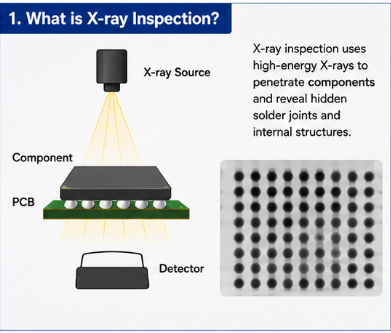
X-ray inspection works on the principle of differential absorption. Denser materials (solder, copper) absorb more X-rays and appear darker. Less dense materials (PCB laminate, plastic components) absorb fewer X-rays and appear lighter.

Basic components of an X-ray system:

  • X-ray tube – Generates X-rays

  • Sample stage – Holds and moves the PCB (X, Y, rotation, tilt)

  • Detector – Captures the X-rays that pass through the sample

  • Computer – Processes the image and performs measurements

What the image shows:

  • Solder joints – Dark (high density)

  • PCB and components – Lighter (lower density)

  • Voids – Bright spots inside dark solder (air is low density)

  • Bridging – Dark connection between two joints


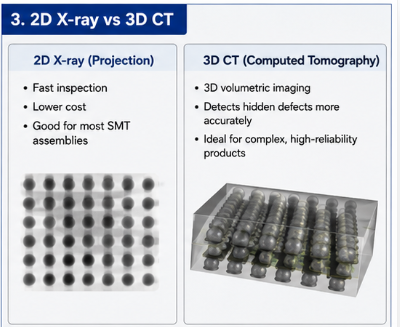
2D X-Ray vs. 3D X-Ray (CT)

2D X-Ray

The X-ray source and detector are fixed; the board moves between them. The result is a single transmission image.

Advantages:

  • Faster (seconds to minutes per board)

  • Lower cost

  • Sufficient for most BGA and void inspection

Limitations:

  • Overlap – components can block each other

  • Limited depth information (cannot measure void height)

  • Head-in-pillow may be invisible at certain angles

Best for:

  • BGA ball presence and bridging

  • Void area measurement (projected area)

  • QFP and connector lead inspection

  • General process validation

3D X-Ray (Computed Tomography / CT)

The X-ray source and detector rotate around the sample, capturing multiple images from different angles. Computer reconstruction creates a 3D model.

Advantages:

  • No overlap – see inside stacked components

  • True void volume measurement (not just area)

  • Can see head-in-pillow from angles

  • Solder joint shape analysis

Limitations:

  • Much slower (minutes to hours per board)

  • Much higher cost (3-10x 2D systems)

  • Large boards may exceed field of view

Best for:

  • Failure analysis (why did this joint fail?)

  • POP (package-on-package) inspection

  • High-reliability applications (aerospace, medical)

  • Process development and validation

Which to choose? For production inspection of BGAs, 2D X-ray is sufficient for most manufacturers. Use 3D CT for failure analysis and high-reliability process validation.


What X-Ray Reveals – Defect by Defect

BGA Bridging

Two adjacent balls are connected by solder.

2D X-ray appearance: Dark, irregular shape connecting two round balls.
Measurement: Bridge width or distance between balls.

Acceptance criteria (IPC-A-610): Any bridging is a defect unless the component specification allows otherwise.

BGA Missing Ball

A ball is completely absent.

2D X-ray appearance: Bright spot where a dark ball should be.
Measurement: Count balls present vs. expected.

Voids

Air pockets inside the solder joint.

2D X-ray appearance: Bright spots inside dark ball.
Measurement: Void area as percentage of ball area (2D) or void volume as percentage (3D).

Acceptance criteria (IPC-7095):

  • Single void <50% of ball diameter generally acceptable

  • Total void area <25% of joint area for critical applications

  • Voids near pad surface more concerning than voids near component side

Head-in-Pillow (HiP)

The ball melted but did not collapse into the paste.

2D X-ray appearance: May look like a normal joint from top-down. Requires angled X-ray to see the separation.

Angled X-ray: Tilt the board 20-45 degrees. A HiP joint will show a gap between the ball and the pad.

Cracked Solder Ball

A crack through the ball, usually near the component or pad interface.

2D X-ray appearance: May be invisible unless the crack is wide. High-resolution systems can see fine cracks.

3D CT appearance: Clearly visible as a separation in the reconstructed volume.

Component Tilt (BGA)

The BGA is not parallel to the PCB.

2D X-ray appearance: Outer balls appear larger (or smaller) than inner balls because of the angle.
Measurement: Compare ball sizes across the array.


Setting Up X-Ray Inspection – Practical Guidelines

Step 1: Define what you need to inspect

  • Which components have hidden joints? (BGAs, LGAs, POP, some connectors)

  • What defects are most likely? (Voids, bridging, HiP)

  • What is the acceptance criteria? (Customer spec, IPC standard)

Step 2: Select X-ray system


Production Volume Recommended System
Low (<10 boards per day) Manual 2D X-ray
Medium (10-100 boards/day) Automated 2D X-ray (programmable inspection)
High (>100 boards/day) Inline 2D X-ray (integrated with line)
Failure analysis 3D CT (benchtop)

Step 3: Create inspection programs

For automated systems:

  • Teach the system to find fiducials on the board

  • Define regions of interest (ROI) around each BGA or hidden joint

  • Set pass/fail thresholds (void percentage, bridging detection)

  • Save the program for repeat use

Step 4: Determine sampling plan


Application Recommended Sampling
Process setup / first article 100% of boards until stable
High-volume consumer Every [X] boards (e.g., 1 per shift or 1 per 100 boards)
Automotive 100% inspection of critical BGAs
Medical / Aerospace 100% inspection of all hidden joints

Step 5: Train operators

Operators need to recognize:

  • Good joints (uniform, round, no voids or bridging)

  • Defects (bridging, missing ball, excessive voids, HiP)

  • Artifacts (board features that look like defects)

Common artifacts:

  • Vias under BGAs (appear as bright spots – not voids)

  • Copper traces (dark lines – can be mistaken for bridging)

  • Component leads near BGAs (can overlap in 2D image)


Measuring Voids – Practical Guidance

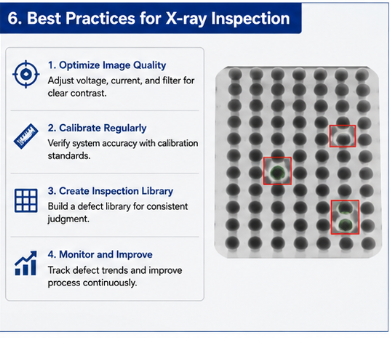
Void measurement is the most common X-ray application.

How to measure void area (2D):

  1. Draw a circle around the entire ball

  2. Calculate the total ball area

  3. Draw circles around each void (or use automated thresholding)

  4. Sum the void areas

  5. Calculate percentage = (total void area / ball area) x 100

Automated software does this in seconds. Manual measurement is time-consuming and less accurate.

Void acceptance guidelines:


Application Maximum Void Area
Consumer electronics <25% of joint area (IPC-7095 Class 1)
Industrial / general <25% (IPC-7095 Class 2)
Automotive / medical <15% or as specified
Aerospace <10% or as specified

Note: Void location matters. A void at the pad interface (bottom of the ball) is more problematic than a void at the component side. Some systems can estimate void location from 2D images; CT is required for precise location.


Detecting Head-in-Pillow – The Challenge

HiP is the most difficult common BGA defect to detect with standard 2D X-ray. From the top, a HiP joint can look perfectly normal.

Detection methods:

1. Angled X-ray

  • Tilt the board 20-45 degrees

  • HiP joints show a separation between ball and pad

  • Time-consuming (must angle for each BGA)

2. 3D CT

  • Clearly shows the separation

  • Slow and expensive for production

3. Electrical test

  • HiP joints may pass opens test initially but fail under thermal or mechanical stress

  • Not a detection method but a final verification

Best practice: Prevent HiP through process control rather than relying on X-ray detection. Optimize reflow profile (extend TAL, reduce delta T) and use fresh paste.


X-Ray Safety

X-ray systems generate ionizing radiation. Safety is mandatory.

Key safety features on modern X-ray systems:

  • Interlocked enclosure – System cannot operate with door open

  • Lead-lined cabinet – Contains radiation

  • Emergency stop buttons

  • Radiation monitoring – Some systems have internal sensors

Operator requirements:

  • Do not bypass safety interlocks

  • Do not put hands inside during operation

  • Follow manufacturer's safety procedures

  • Wear dosimeter badge if required by local regulations (usually not for fully enclosed systems)

Regulatory compliance:

  • In the US: FDA/CDRH requirements for cabinet X-ray systems

  • In Europe: CE mark and local radiation regulations

  • Typical exposure at operator position: Negligible (<< natural background radiation) for properly enclosed systems

Note: X-ray systems sold for PCB inspection are fully enclosed. The operator is not exposed to radiation during normal use. Only service technicians need special training.


X-Ray System Selection – Key Specifications


Specification What It Means What to Look For
Tube voltage (kV) Penetration power 100-160kV for PCBs; higher for denser boards
Focal spot size (µm) Resolution <10µm for fine-pitch BGA; 15-25µm for general
Detector type Image quality Flat panel (digital) preferred over image intensifier
Field of view (FOV) Maximum inspection area Should cover largest PCB
Magnification Zoom capability Optical (lens) + geometric (move sample closer)
Automated inspection Programmable Essential for production; optional for R&D

Price ranges (approximate – verify with vendors):


System Type Typical Price Range
Manual 2D benchtop 30,000 - 80,000
Automated 2D 80,000 - 200,000
Inline 2D 200,000 - 400,000
Benchtop 3D CT 150,000 - 300,000
Production 3D CT $400,000+

X-Ray Inspection Log

For traceability and quality records:


Date Board ID / Lot BGA Location Inspection Result Void % (if measured) Operator
      Pass / Fail    

Keep inspection images for critical applications (automotive, medical, aerospace).


Conclusion

X-ray inspection is the only reliable way to verify hidden solder joints under BGAs and other area-array packages. It reveals bridging, missing balls, voids, and – with angled or 3D systems – head-in-pillow defects.

For most SMT lines assembling BGAs, a 2D X-ray system is sufficient. Use it for:

  • Process validation (first article inspection)

  • Periodic sampling during production

  • Rework verification

If you assemble high-reliability products (automotive, medical, aerospace) or need true void volume measurement, consider 3D CT.

Remember: X-ray detects defects but does not prevent them. Use X-ray as part of a complete process control strategy – not as a substitute for good printing, placement, and reflow.

The best X-ray inspection is the one you don't need because your process is under control. But until that day, X-ray is essential for seeing the unseen.

Vissza a blogra

Üzenet közzététele

Felhívjuk figyelmét, hogy közzététel előtt a megjegyzéseket jóvá kell hagyni