|
Introduction In surface-mount assembly, some defects are invisible to the naked eye and even to automated optical inspection (AOI). Hidden solder joints under BGAs, voids in component leads, and cracks in solder balls cannot be seen from the top or side. X-ray inspection solves this problem by looking through the component body. This article explains the basics of X-ray inspection for SMT assembly: how it works, what defects it detects, when to use 2D vs. 3D (CT) systems, and practical guidelines for setting up an X-ray inspection program. Whether you assemble medical devices, automotive electronics, or consumer products, X-ray is often the only way to verify hidden joint quality.
Why X-Ray Is Necessary Modern electronics use increasingly hidden interconnections. BGAs, LGAs, CSPs, and POP (package-on-package) components have solder joints completely under the component body. Optical inspection cannot see them. Defects that require X-ray:
Industry standards requiring X-ray:
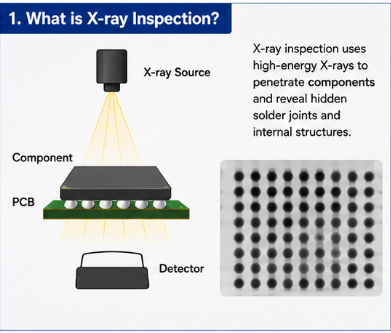
Even if not required by a standard, X-ray is best practice for any product with BGAs or other hidden interconnections. How X-Ray Inspection Works X-ray inspection works on the principle of differential absorption. Denser materials (solder, copper) absorb more X-rays and appear darker. Less dense materials (PCB laminate, plastic components) absorb fewer X-rays and appear lighter. Basic components of an X-ray system:
What the image shows:
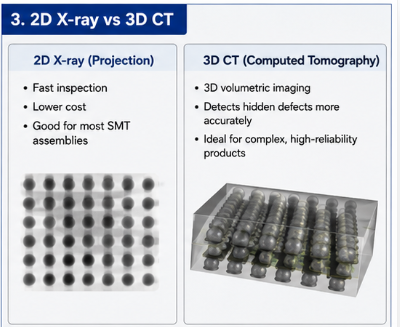
2D X-Ray vs. 3D X-Ray (CT)
2D X-Ray The X-ray source and detector are fixed; the board moves between them. The result is a single transmission image. Advantages:
Limitations:
Best for:
3D X-Ray (Computed Tomography / CT) The X-ray source and detector rotate around the sample, capturing multiple images from different angles. Computer reconstruction creates a 3D model. Advantages:
Limitations:
Best for:
Which to choose? For production inspection of BGAs, 2D X-ray is sufficient for most manufacturers. Use 3D CT for failure analysis and high-reliability process validation. What X-Ray Reveals – Defect by Defect BGA Bridging Two adjacent balls are connected by solder. 2D X-ray appearance: Dark, irregular shape connecting two round balls. Acceptance criteria (IPC-A-610): Any bridging is a defect unless the component specification allows otherwise. BGA Missing Ball A ball is completely absent. 2D X-ray appearance: Bright spot where a dark ball should be. Voids Air pockets inside the solder joint. 2D X-ray appearance: Bright spots inside dark ball. Acceptance criteria (IPC-7095):
Head-in-Pillow (HiP) The ball melted but did not collapse into the paste. 2D X-ray appearance: May look like a normal joint from top-down. Requires angled X-ray to see the separation. Angled X-ray: Tilt the board 20-45 degrees. A HiP joint will show a gap between the ball and the pad. Cracked Solder Ball A crack through the ball, usually near the component or pad interface. 2D X-ray appearance: May be invisible unless the crack is wide. High-resolution systems can see fine cracks. 3D CT appearance: Clearly visible as a separation in the reconstructed volume. Component Tilt (BGA) The BGA is not parallel to the PCB. 2D X-ray appearance: Outer balls appear larger (or smaller) than inner balls because of the angle. Setting Up X-Ray Inspection – Practical Guidelines Step 1: Define what you need to inspect
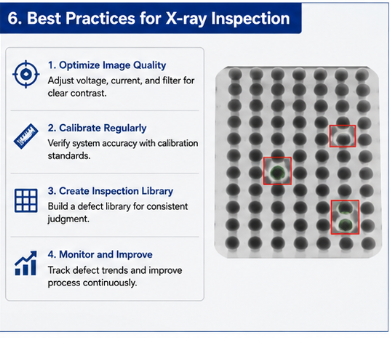
Step 2: Select X-ray system
Step 3: Create inspection programs For automated systems:
Step 4: Determine sampling plan
Step 5: Train operators Operators need to recognize:
Common artifacts:
Measuring Voids – Practical Guidance Void measurement is the most common X-ray application. How to measure void area (2D):
Automated software does this in seconds. Manual measurement is time-consuming and less accurate. Void acceptance guidelines:
Note: Void location matters. A void at the pad interface (bottom of the ball) is more problematic than a void at the component side. Some systems can estimate void location from 2D images; CT is required for precise location. Detecting Head-in-Pillow – The Challenge HiP is the most difficult common BGA defect to detect with standard 2D X-ray. From the top, a HiP joint can look perfectly normal. Detection methods: 1. Angled X-ray
2. 3D CT
3. Electrical test
Best practice: Prevent HiP through process control rather than relying on X-ray detection. Optimize reflow profile (extend TAL, reduce delta T) and use fresh paste. X-Ray Safety X-ray systems generate ionizing radiation. Safety is mandatory. Key safety features on modern X-ray systems:
Operator requirements:
Regulatory compliance:
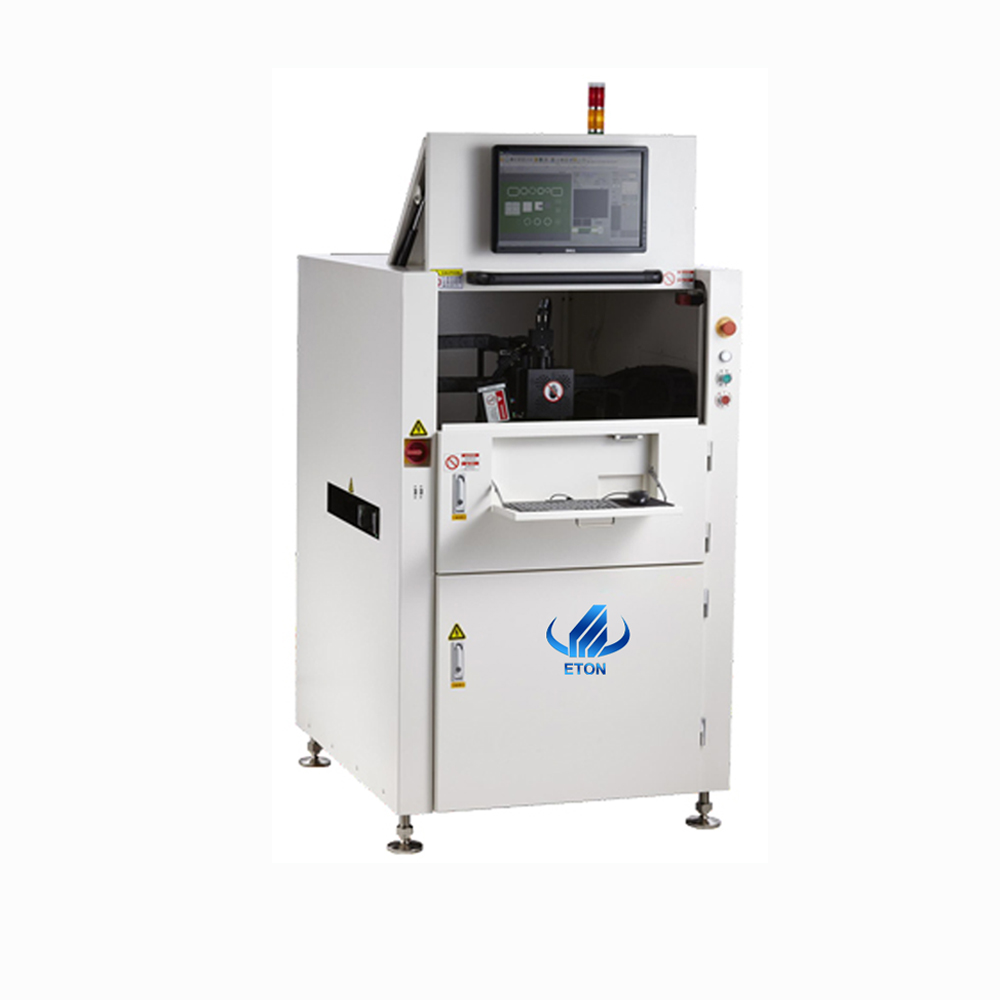
Note: X-ray systems sold for PCB inspection are fully enclosed. The operator is not exposed to radiation during normal use. Only service technicians need special training. X-Ray System Selection – Key Specifications
Price ranges (approximate – verify with vendors):
X-Ray Inspection Log For traceability and quality records:
Keep inspection images for critical applications (automotive, medical, aerospace).
Conclusion X-ray inspection is the only reliable way to verify hidden solder joints under BGAs and other area-array packages. It reveals bridging, missing balls, voids, and – with angled or 3D systems – head-in-pillow defects. For most SMT lines assembling BGAs, a 2D X-ray system is sufficient. Use it for:
If you assemble high-reliability products (automotive, medical, aerospace) or need true void volume measurement, consider 3D CT. Remember: X-ray detects defects but does not prevent them. Use X-ray as part of a complete process control strategy – not as a substitute for good printing, placement, and reflow. The best X-ray inspection is the one you don't need because your process is under control. But until that day, X-ray is essential for seeing the unseen. |
X-Ray Inspection for SMT Assembly – Seeing the Unseen
28 mag 2026 ETON