|
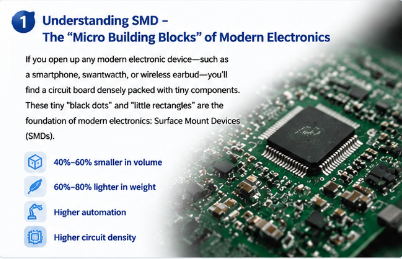
If you have ever disassembled a modern electronic device—such as a smartphone, smartwatch, or wireless earbud—you were likely amazed by the densely packed tiny components on the circuit board. These barely visible black dots and miniature blocks are the fundamental building units of modern electronics: Surface Mount Devices (SMDs). The widespread adoption of SMDs has transformed electronics from bulky and mechanical systems into highly integrated, compact, and efficient products, reshaping the entire manufacturing industry. |
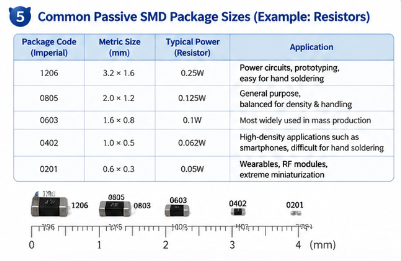
| Package | Metric Size (mm) | Power Rating | Application |
|---|---|---|---|
| 1206 | 3.2 × 1.6 | 0.25W | Easy hand soldering, prototyping |
| 0805 | 2.0 × 1.2 | 0.125W | General-purpose design |
| 0603 | 1.6 × 0.8 | 0.1W | Most common in mass production |
| 0402 | 1.0 × 0.5 | 0.062W | High-density mobile devices |
| 0201 | 0.6 × 0.3 | 0.05W | Wearables and RF modules |
As electronics continue to shrink, even smaller packages like 01005 are being adopted in advanced applications.
Active Components: The “Brain” of the System
Active components control current flow, amplify signals, and perform logical operations.
Common active devices include transistors, integrated circuits (ICs), and diodes.
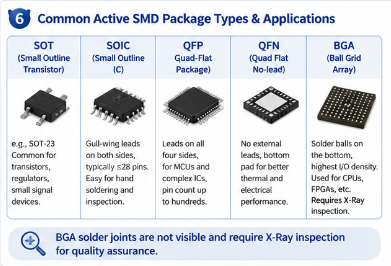
Typical package types include:
- SOT (Small Outline Transistor): compact transistor package, SOT-23 is the most common
- SOIC (Small Outline IC): gull-wing leads, suitable for moderate complexity ICs
- QFP (Quad Flat Package): four-side leads for microcontrollers and complex ICs
- QFN (Quad Flat No-lead): compact footprint with excellent thermal and electrical performance
- BGA (Ball Grid Array): high-density solder ball array used in CPUs, GPUs, and FPGAs; requires X-ray inspection due to hidden joints
4. How to Choose the Right SMD Package
Selecting an appropriate package involves balancing multiple engineering factors:
Space Constraints
Smaller devices require smaller components, such as 0402 or 0201 for wearables and compact electronics.
Electrical Performance
High-frequency circuits require low parasitic inductance and capacitance, making 0402 or QFN packages ideal.
Thermal Requirements
Power components must efficiently dissipate heat, often using QFN or thermally enhanced packages.
Manufacturability
Prototypes often use larger packages (1206, SOIC) for easier handling, while mass production shifts to smaller components for cost and density optimization.
5. Conclusion: The Invisible Foundation of Modern Electronics
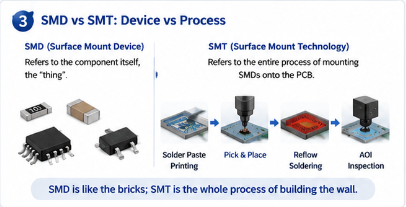
SMD technology represents far more than miniaturization—it is a complete transformation of electronics manufacturing. From PCB design and material science to automated assembly and inspection systems, every aspect of modern electronics is built around the principles of density, precision, and scalability.
The smartphones, wearables, and intelligent systems we use today are all made possible by these microscopic components working together in highly complex systems.
Understanding SMD is not just about understanding components—it is about understanding the foundation of modern electronic civilization itself.